Getting someone interested in your business is one thing. Getting them to actually book is another.
- The Gap Between “I’m Interested” and “I’ll Book”
- A QR Code Can Be a Shortcut to the Moment That Matters
- Put the QR Code Where Booking Intent Already Exists
- Think of the QR Code as a Door, Not a Sign
- What Should an Appointment QR Code Open?
- One Business Can Have Several Booking Journeys
- Turn Printed Materials Into Booking Opportunities
- Make the Booking Page Match the Promise
- Don't Turn Booking Into a Form-Filling Marathon
- Measure Bookings, Not Just Scans
- The Best Booking QR Removes a Decision
A customer might see your salon, discover your consulting service, visit a property, meet your sales team, or pick up a brochure and think, “I should book this.” Then reality kicks in. They have to remember your business name, find your website, locate the booking page, figure out which service they need, check availability, and finally complete the appointment.
That is a lot of momentum to lose.
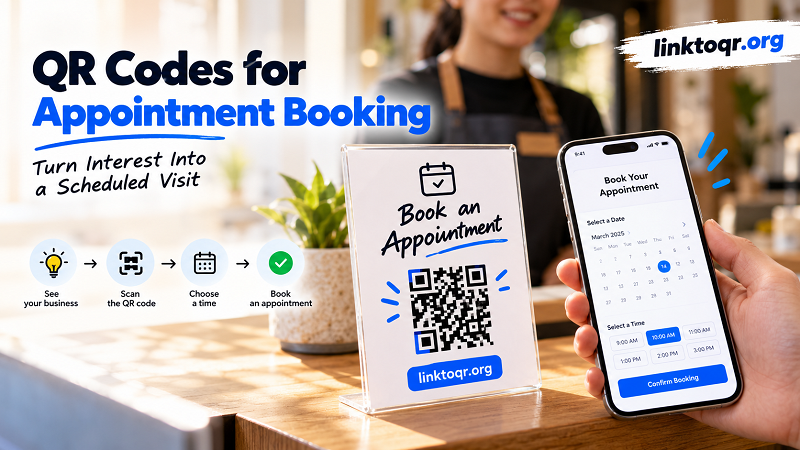
A QR code can shorten that journey by putting the next step directly in front of the customer. Instead of asking people to search for your business later, you can connect a physical interaction with the exact online destination where they can schedule an appointment.
The Gap Between “I’m Interested” and “I’ll Book”
Customer intent can disappear surprisingly fast.
Imagine someone walking past a salon and noticing a service they want. They could visit the website later, search for the salon, find the correct location, browse the services, and make an appointment. Or they could scan a QR code while the idea is fresh and go straight to the booking experience.
The difference is not necessarily stronger motivation. It is fewer steps.
The same principle works for real estate agents, personal trainers, medical offices, consultants, photographers, repair businesses, beauty professionals, and countless other appointment-based services.
The closer you can place the booking opportunity to the moment of interest, the less work the customer has to do.
A QR Code Can Be a Shortcut to the Moment That Matters
The most useful way to think about an appointment QR code is not as a piece of technology. Think of it as a shortcut.
A customer sees an offer.
They become curious.
They decide they want to take the next step.
The QR code gives them that next step immediately.
This creates a simple journey:
Interest → Scan → Booking page → Choose → Confirm
Compare that with the traditional route:
Interest → Remember business → Search online → Find website → Find booking page → Choose → Confirm
Every extra action creates another chance for the customer to get distracted, postpone the decision, or simply forget.
That is why a QR code can be particularly useful when your business relies on appointments rather than impulse purchases.
Put the QR Code Where Booking Intent Already Exists
Not every location has the same value.
A QR code sitting on a random wall might be visible, but visibility alone does not create booking intent. The better question is: When is the customer most likely to want to schedule something?
For a salon, that moment might be while someone is looking at service prices.
For a real estate agent, it could be immediately after a property tour.
For a consultant, it might happen after someone reads a service brochure.
For a fitness business, it could be after someone sees a class schedule.
For a photographer, it might be after a potential client looks through a portfolio.
The strongest placement is often the point where curiosity naturally turns into action.
Think of the QR Code as a Door, Not a Sign
A QR code sitting by itself does not tell people why they should scan it.
“Scan Me” is technically an instruction, but it is not much of a reason.
A stronger message connects the scan with the desired outcome:
- Book an Appointment
- Schedule a Consultation
- Choose Your Time
- Reserve Your Spot
- Book a Property Tour
The QR code handles the transition. The surrounding message explains where that transition leads.
This small distinction matters because people do not scan QR codes simply because QR codes exist. They scan when the action promises something useful.
What Should an Appointment QR Code Open?
The destination should match the customer's level of intent.
If your customer already knows exactly what they want, a direct booking page may be ideal. They scan and immediately see available times.
If customers need to choose between several services, a service selection page can make more sense.
If appointments require some discussion first, an appointment request form or consultation page may be better.
And if your business operates around scheduled events, the destination might be an event registration page rather than a traditional appointment calendar.
The golden rule is simple: don't make someone scan a booking QR code and then hunt around your website for the booking button.
If the QR promises an appointment, the destination should make that appointment easy to start.
One Business Can Have Several Booking Journeys
Different customers do not always want the same thing.
A salon might have separate booking journeys for haircuts, coloring, treatments, and consultations. A real estate business could have different paths for property tours, buyer consultations, and seller inquiries. A professional service company might offer discovery calls, consultations, and quote requests.
That does not mean you need a QR code for every tiny action.
Instead, think about customer intent.
If two audiences have dramatically different next steps, sending them to the same generic page can create unnecessary friction. A contextual QR code can point each audience toward the most relevant destination.
The goal is not to create more QR codes. The goal is to create fewer unnecessary decisions.
Turn Printed Materials Into Booking Opportunities
Printed marketing is often treated as the end of the communication. It does not have to be.
A business card can become a doorway to a consultation.
A brochure can lead directly to a service appointment.
A storefront display can turn passing interest into a scheduled visit.
A printed quotation can give a prospect an immediate way to book a follow-up call.
An appointment card can make rebooking easier.
A flyer can move someone from discovering an offer to reserving a time slot without requiring them to type a URL.
When you already have the right booking destination, you can make a link into a qr code and bring that digital action into the physical world.
The important part is the context around the QR. Tell people what they will get after scanning instead of expecting them to guess.
Make the Booking Page Match the Promise
There is an easy mistake to make here: optimizing the QR code while ignoring what happens after the scan.
Suppose a printed sign says:
Book a 30-Minute Consultation
The customer scans it and lands on a homepage filled with company history, blog posts, product categories, and five different navigation menus.
Technically, the QR works.
Marketing-wise, it missed the point.
The destination should continue the promise made by the printed message. If the customer expects to book, booking should be obvious. If they expect to choose a service, that choice should be immediately available.
Think of the QR and landing page as one experience rather than two separate pieces of marketing.
Don't Turn Booking Into a Form-Filling Marathon
A fast entrance can still lead to a painfully slow booking process.
Long forms, unnecessary questions, complicated calendars, forced account creation, unclear availability, and confusing service options can destroy the advantage created by the QR code.
Ask for the information you actually need.
Make the available times easy to understand.
Keep the number of decisions reasonable.
And make the final confirmation unmistakable.
The QR code gets the customer through the door. Your booking experience determines whether they stay.
Measure Bookings, Not Just Scans
QR scans are useful, but they are not the finish line.
Suppose one campaign generates 1,000 scans and only five completed appointments. Another generates 300 scans and 40 appointments.
Which one performed better?
The answer is obvious once you stop treating scans as the ultimate goal.
For appointment campaigns, the useful journey is:
QR scans → Booking page visits → Booking starts → Completed appointments
This gives you a much clearer picture of whether the QR placement, message, destination, and booking experience are actually working together.
A QR code that gets fewer scans but produces significantly more appointments can be far more valuable than one that generates impressive scan numbers with little business impact.
The Best Booking QR Removes a Decision
A QR code will not magically create demand for your service. It cannot fix an unattractive offer, an unavailable calendar, or a frustrating booking system.
What it can do is remove unnecessary work when someone is already interested.
That is the real opportunity.
Instead of asking a potential customer to remember your business, search for your website, navigate through several pages, and figure out how to book, give them a direct bridge from “That looks interesting” to “I'm booked.”
When the timing, message, destination, and booking experience all line up, a tiny square on a business card, window, brochure, or sign can become something much more useful: a shortcut from attention to action.