- A Great Presentation Can Still Lead to a Dead End
- Give People a Reason to Stay Connected
- Turn One Presentation Into an Ongoing Conversation
- Make Your LinkedIn Profile Worth the Visit
- Build a Simple Connection Path Before the Event
- What to Do in the First 48 Hours After Your Talk
- Measure the Relationships, Not Just the Numbers
- Common Mistakes That Weaken Post-Event Engagement
- Make Your Next Presentation the Start of Something Bigger
You step off the stage, the audience applauds, and a few people approach you with thoughtful questions. Someone says your presentation gave them a new perspective. Another person wants to discuss an idea you mentioned. For a moment, everything feels promising. Then the next session begins, the room empties, and everyone moves on with their day.
Here’s the catch: getting an audience interested is one thing; giving that interest somewhere to go is another. For conference speakers, consultants, trainers, founders, and industry experts, the real opportunity often starts after the microphone is switched off. A presentation can introduce your ideas to dozens or hundreds of people, but without a practical way to continue the conversation, much of that momentum disappears.
LinkedIn can help bridge that gap. The trick isn't to collect as many connections as possible. It's to make it easy for the right people to remember you, understand what you offer, and continue engaging with your work long after the event ends.
A Great Presentation Can Still Lead to a Dead End
Conference audiences are busy. They attend multiple sessions, meet new people, exchange business cards, and absorb a steady stream of information. Even when your presentation stands out, people may forget your name, struggle to find the correct LinkedIn profile, or simply run out of time before they can follow up.
This creates a frustrating disconnect. You may have delivered valuable insights, but the people who could benefit most from your expertise never get the chance to explore it further. The problem isn't necessarily the quality of your presentation. It's the lack of a clear bridge between the experience in the room and the relationship that could develop afterward.
Traditional follow-up methods don't always solve this. A business card can get lost in a bag. A slide filled with contact details may be difficult to read from the back of a crowded room. Asking everyone to search for your name later adds another task to an already overloaded day.
The smarter move is to design the next step before you take the stage. If someone finds your talk valuable, what should they do next? Where can they find the supporting resources? How can they keep up with your ideas? When those answers are obvious, the transition from audience member to professional connection becomes much more natural.
Give People a Reason to Stay Connected
A LinkedIn connection request is easy to send. A meaningful reason to accept one is much more powerful. If your only invitation is “Connect with me on LinkedIn,” you're asking people to take action without showing them what they stand to gain.
Instead, connect your invitation to the subject of your presentation. A marketing speaker might share a practical campaign-planning worksheet. A cybersecurity expert could publish a checklist that helps teams review their internal practices. A leadership trainer might post a follow-up reflection with discussion questions for managers.
These resources give your audience a concrete reason to return. They also demonstrate that your expertise extends beyond a polished presentation. You're not simply asking people to grow your network; you're offering something useful enough to justify staying in touch.
The resource doesn't need to be elaborate. In fact, a focused, genuinely helpful piece of content can be more effective than a massive download that nobody has time to read. Choose something that solves one specific problem raised during your talk, then make it easy for attendees to find.
Turn One Presentation Into an Ongoing Conversation
Your presentation should be the beginning of a content journey, not an isolated performance. If you discuss a complicated topic in a 30-minute session, there will almost certainly be ideas you couldn't fully explore. Those unanswered questions create natural opportunities for follow-up content.
Consider publishing a short LinkedIn post that expands on one overlooked point, addresses a common objection, or shares a practical example from your experience. You could also invite thoughtful discussion around a question raised during the Q&A session.
This approach gives attendees a reason to revisit your ideas without forcing them into a sales conversation. It also helps people who missed the event discover your expertise through the content you publish afterward.
Most importantly, keep the connection between your original presentation and subsequent posts clear. When people recognize a familiar idea, they're more likely to remember where they encountered you and why your perspective caught their attention.
Make Your LinkedIn Profile Worth the Visit
Imagine an attendee follows your invitation, opens your LinkedIn profile, and finds an outdated headline, a vague introduction, and months-old activity. The presentation may have impressed them, but the profile doesn't reinforce that impression.
Your LinkedIn presence should answer three questions quickly: Who are you? What do you know? Why should someone keep following your work?
Start with your headline. Rather than relying entirely on a job title, communicate your area of expertise and the audience or problem you focus on. Your About section should add context, explain your professional perspective, and help visitors understand what they can expect from your content.
Next, review your Featured section. If you have a relevant presentation, article, case study, or resource, consider highlighting it. Recent posts can also reinforce the ideas you discussed on stage and show that you're actively contributing to your field.
Consistency matters here, but perfection doesn't. You don't need to turn your profile into a personal-branding masterpiece overnight. You simply need to make sure the experience after the click matches the credibility you established during the talk.
Build a Simple Connection Path Before the Event
The best time to think about post-event engagement is before the event begins. A little preparation can prevent a promising interaction from turning into a frustrating search for contact information.
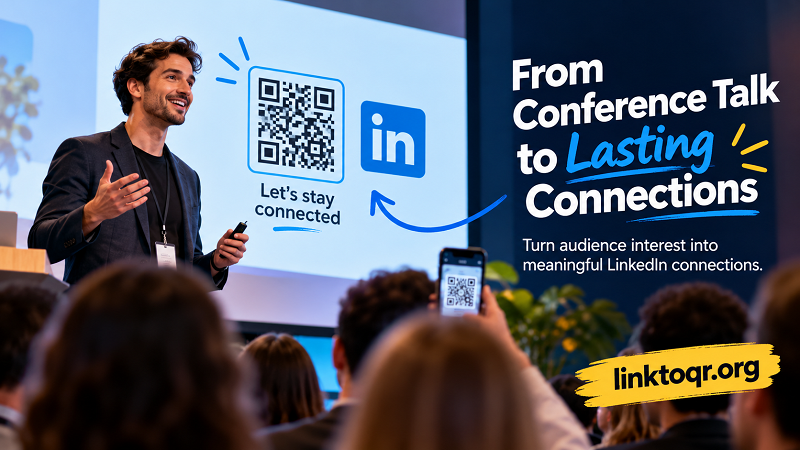
Start by choosing one primary destination for attendees who want to learn more about you. If your goal is to grow a professional network, directing interested people to your LinkedIn profile makes sense. A qr code to linkedin can give attendees a direct route to your profile from a presentation slide, printed handout, or event display, reducing the need to type your name or search through similar profiles.
However, convenience alone won't make people connect. The invitation surrounding the code matters just as much. Instead of displaying a QR code with no explanation, tell attendees what they'll find when they follow it. For example, invite them to connect for additional resources, continue a discussion about a specific topic, or follow a series of posts related to your presentation.
Keep the experience focused. Sending people through several pages before they reach your profile introduces unnecessary friction. Make the destination clear, ensure the code is large enough to scan from the audience's seating area, and test it on multiple phones before presenting.
Also, prepare a backup. A readable LinkedIn profile URL or short link can help attendees who have trouble scanning the code or prefer to access your profile later. If you're presenting in a room with unreliable internet access, this small detail can save an otherwise awkward moment.
The goal is not to make your presentation look more technologically advanced. It's to remove obstacles between genuine interest and a useful next step.
What to Do in the First 48 Hours After Your Talk
Once the event ends, don't disappear for three weeks and expect the conversation to pick up exactly where it left off. People are more likely to remember the presentation while the experience is still fresh, so use the first couple of days to reinforce the value you promised.
First, publish a thoughtful recap. Share one important lesson from your talk, acknowledge a particularly interesting question, or explain an idea that deserves more attention. A useful takeaway is generally more compelling than a generic announcement that you enjoyed speaking at the event.
Second, deliver anything you promised. If you mentioned a resource, supporting document, or follow-up article, make sure it becomes available when attendees expect it. Reliability builds trust. Failing to deliver a promised resource can undermine the impression you worked hard to create on stage.
Third, personalize your follow-up. When you connect with someone who asked a meaningful question or discussed a specific challenge, refer to that conversation. A short, relevant message shows that you remember the interaction and aren't simply sending identical requests to everyone in the room.
Finally, continue the discussion. Respond to comments, answer questions that emerged after the session, and share additional context when it adds value. You don't need to turn every interaction into a long exchange. The aim is to keep useful conversations moving without making people feel as though they've entered an automated sales funnel.
And remember, not every attendee needs the same follow-up. Some will want deeper technical insights. Others may be interested in your broader perspective or future speaking engagements. Pay attention to what people actually respond to instead of assuming one message will work for everyone.
Measure the Relationships, Not Just the Numbers
It's tempting to judge a post-event strategy by how many people scan a QR code or send connection requests. Those numbers can provide useful clues, but they don't tell the whole story.
A hundred new connections who never interact with your work may be less valuable than ten relevant professionals who start meaningful conversations. The real measure of success depends on what you're trying to achieve: professional visibility, knowledge sharing, business development, collaboration, or opportunities to speak at future events.
Choose a few indicators that match your goals. These might include relevant connection requests, substantive comments on follow-up posts, direct questions about your topic, invitations to continue a discussion, or qualified professional opportunities that arise later.
You can also compare different approaches across events. Did attendees respond better to a resource-focused invitation or a simple request to follow your LinkedIn activity? Did a presentation slide generate more interest than a printed handout? Small comparisons can help you refine your approach over time.
Be careful with attribution, though. A QR scan doesn't automatically equal a new connection, and a new connection doesn't automatically result from one presentation. LinkedIn's available analytics and your own follow-up records may help you identify patterns, but they won't necessarily reveal every step in an attendee's decision-making process.
The objective is to learn which experiences encourage meaningful engagement, not to manufacture impressive numbers for a report.
Common Mistakes That Weaken Post-Event Engagement
Even experienced speakers can make their follow-up strategy harder than it needs to be. A few avoidable mistakes can create friction or leave attendees unsure about what to do next.
- Making the invitation too vague. “Find me online” gives people little direction. Tell them where to go and why it matters.
- Treating every attendee as a sales lead. Someone who enjoyed your presentation may simply want to learn more. Give the relationship room to develop before pushing a commercial offer.
- Promising resources you never deliver. If your invitation mentions additional material, prepare it before the event and make it accessible afterward.
- Overloading the final slide. Too many links, social icons, and competing calls to action can make the next step less obvious. Prioritize one main action.
- Ignoring the conversation once the event ends. A connection request is only an opening. Relevant posts, thoughtful replies, and reliable follow-through help turn that opening into an ongoing professional relationship.
None of these mistakes requires an expensive platform or complicated marketing automation to fix. Most can be addressed with clearer communication, a little preparation, and a genuine commitment to providing value after the presentation.
Make Your Next Presentation the Start of Something Bigger
A successful conference talk doesn't have to end when the audience leaves the room. It can lead to fresh perspectives, valuable professional relationships, future collaborations, and conversations that continue long after the event has faded from everyone's calendar.
The key is to stop treating audience attention as the finish line. Give people a clear reason to stay connected, make your professional presence worth revisiting, and follow through while the discussion is still relevant. Keep the process simple enough for attendees to use and sustainable enough for you to maintain.
You won't turn every person in the room into a long-term connection, and that's perfectly fine. Focus on making the next step easy for the people who genuinely care about your ideas. When you consistently deliver value beyond the stage, your presentations can become more than memorable moments. They can become the starting point for relationships that keep growing.