- When a Simple Repair Turns Into an Administrative Headache
- The Real Cost of Poor Maintenance Communication
- A Maintenance Request Should Start Where the Problem Happens
- What a Useful Maintenance Report Actually Needs
- From Scanned Code to Completed Repair: Following the Request
- One Building, Different Maintenance Needs
- Setting Up a Maintenance Request QR Code Without Complicating Things
- A Faster Repair Process Starts With Better Information
A dripping faucet. A broken hallway light. An elevator that suddenly decides it has had enough for the day. Apartment maintenance problems are rarely convenient, but reporting them shouldn't feel like another problem residents have to solve.
For property managers, the real headache often starts after something breaks. A tenant sends a text message without mentioning their apartment number. Another calls the front desk but forgets to explain exactly where the issue is. Someone else emails a photo that gets buried beneath dozens of unrelated messages. Before anyone picks up a wrench, the management team is already playing detective.
It's a surprisingly expensive way to handle relatively simple problems. And while no technology can magically repair a leaking pipe, a smarter reporting process can make sure the right information reaches the right people before a minor inconvenience turns into a much bigger mess.
That's where QR codes come in. By placing scannable codes near shared facilities, equipment, and other relevant locations, apartment communities can give residents a direct route to report maintenance issues without searching for contact details or figuring out which department to call.
When a Simple Repair Turns Into an Administrative Headache
Imagine managing a residential building with 150 apartments, a shared laundry room, a fitness center, underground parking, and several common areas. Something breaks almost every day. Not necessarily anything dramatic, but enough to keep the maintenance team busy.
Now imagine every resident reports problems differently. Some prefer phone calls, others send emails, and plenty of people simply message the property manager whenever they remember. The information arrives through multiple channels, in different formats, and often without the details needed to take action.
The result is a communication maze.
A resident might report that the washing machine is broken without identifying which machine. A maintenance worker arrives only to discover that the problem is actually with another unit. A hallway light gets reported twice because nobody knows whether the first request was received. Meanwhile, the property manager spends valuable time searching through messages instead of coordinating repairs.
These aren't necessarily failures of individual employees. They're symptoms of a reporting process that relies too heavily on scattered communication.
When maintenance requests don't follow a consistent path, even a well-staffed property management team can struggle to stay organized.
The Real Cost of Poor Maintenance Communication
A maintenance request isn't just a message saying something is broken. It's the beginning of a service interaction that affects how residents perceive the entire property.
When reporting an issue feels difficult, tenants may postpone it. A small leak might go unreported because someone doesn't want to call the office. A damaged piece of gym equipment might remain unused because residents aren't sure whom to contact.
Delays can create consequences beyond inconvenience. Water damage can spread, faulty equipment can become a safety concern, and minor defects can require more expensive repairs when left unattended.
There's also the human side of the problem. Residents don't always expect everything to be fixed immediately, but they do expect their concerns to be acknowledged. Silence creates uncertainty. Uncertainty creates frustration. And repeated frustration can gradually damage the relationship between tenants and property management.
For management teams, poor communication also creates operational friction. Staff members spend time requesting missing details, technicians make unnecessary trips, and duplicate reports complicate prioritization.
The bigger issue isn't simply how quickly a repair gets completed. It's how much unnecessary effort is required just to get the repair started.
A Maintenance Request Should Start Where the Problem Happens
Here's a practical idea: instead of asking residents to remember a phone number or search through an email thread, let them report the problem right where they encounter it.
Place a QR code in the shared laundry room. Put another near the fitness center equipment. Add one in the parking area or beside relevant building facilities.
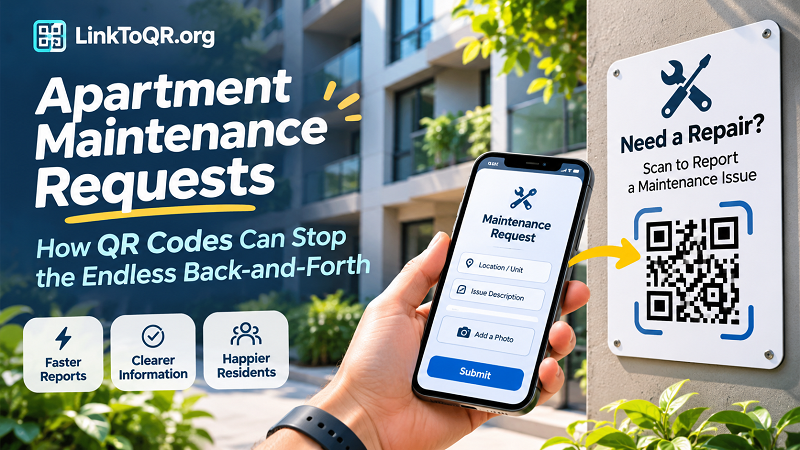
When residents scan the code, their phones open a mobile-friendly maintenance request form. They can describe the issue, upload a photo, provide their contact details, and submit the report without leaving the area.
This small change removes several unnecessary steps from the reporting process.
Consider a resident who discovers that a washing machine isn't draining properly. Instead of remembering the machine number, walking back to their apartment, and eventually sending an incomplete email, they can scan a nearby code and submit the information while the problem is still right in front of them.
The same concept works for broken door handles, damaged furniture, malfunctioning exercise equipment, or lighting problems in common areas.
Location-based reporting also gives property managers an opportunity to make forms more relevant. A code near the gym could open a form with fitness equipment categories, while a code in the parking garage could direct residents toward vehicle access, lighting, or gate-related issues.
The goal isn't to put a QR code on every square inch of the building. It's to remove friction at the moments when reporting an issue should be easiest.
What a Useful Maintenance Report Actually Needs
A QR code can make reporting easier, but it can't compensate for a poorly designed form. If residents scan a code only to encounter twenty confusing questions, the technology hasn't solved much.
The form should collect enough information to help the maintenance team understand the situation without turning a simple report into a paperwork marathon.
Start with the building and apartment number, where applicable. For shared facilities, ask residents to identify the exact location or equipment involved. A report saying "the dryer is broken" isn't nearly as helpful as one identifying the laundry room and the specific dryer.
Next, provide a few straightforward maintenance categories. Plumbing, electrical, appliances, heating and cooling, structural concerns, and common-area equipment are reasonable starting points. Avoid overwhelming residents with technical terminology they may not understand.
A short description field allows tenants to explain what happened in their own words. Photo uploads are especially useful because they give technicians an early look at the issue. A picture of a leaking pipe or damaged door can communicate details that would otherwise require several follow-up questions.
Contact information is another essential element. The maintenance team may need to clarify something, arrange access to an apartment, or notify the resident about scheduling.
Finally, include an urgency selection where appropriate. However, residents should never be expected to determine technical risk on their own. The form should clearly explain that immediate threats to personal safety, fire, gas leaks, flooding, or other emergencies must be reported through the property's designated emergency channels. A QR form is not an emergency response system.
Good form design is about balance: enough information to support a useful decision, but not so much that residents abandon the process halfway through.
From Scanned Code to Completed Repair: Following the Request
Submitting a maintenance report is only the opening move. The real value comes from what happens afterward.
Once a resident submits the form, the information should reach the appropriate property management team or maintenance coordinator. Depending on the software being used, the request may enter a shared inbox, a property management platform, or a dedicated maintenance tracking system.
From there, someone reviews the details and determines the next action. A technician can be assigned, additional information can be requested, and the repair can be scheduled according to its urgency and available resources.
Status updates are equally important. Residents should have a reasonable way to know whether their request has been received, assigned, scheduled, or completed. Nobody enjoys wondering whether their report disappeared into a digital black hole.
For example, a simple maintenance workflow might look like this:
- Submitted: The resident sends the maintenance report.
- Received: Management acknowledges the request.
- Assigned: The issue is routed to the appropriate technician.
- In Progress: Work begins or an inspection is scheduled.
- Completed: The repair is finished and documented.
The exact workflow will depend on the property management system. Some platforms offer automated notifications and ticket tracking, while smaller properties may rely on shared spreadsheets or email-based processes.
One important distinction: generating a QR code does not automatically create a maintenance management system. The QR code provides the entry point. The form collects information. The software and people behind it turn that information into completed work.
That distinction matters because residents don't care how sophisticated the QR code looks. They care whether the broken washing machine gets fixed.
One Building, Different Maintenance Needs
A residential property isn't a single environment with identical reporting requirements. Different locations create different problems, and the reporting experience should reflect that.
In shared laundry rooms, residents may need to identify individual machines, report drainage problems, or describe unusual noises. In fitness centers, reports might involve damaged equipment, faulty displays, or safety concerns. Parking garages have their own set of issues, including malfunctioning gates, poor lighting, and damaged access controls.
A property manager could use location-specific QR codes to direct each report to a more relevant form. This reduces the amount of information residents need to enter manually and helps the maintenance team understand where a problem originated.
For example, a code attached near a specific piece of equipment could open a form that already identifies its location or equipment number. Residents would only need to describe the problem and provide any additional details.
There is one practical consideration: every printed code should be clearly labeled. A small instruction such as "Scan to Report a Maintenance Issue" tells residents exactly what the code does. Avoid mysterious, unlabeled QR codes that leave people wondering whether they're opening a maintenance form or signing up for something unexpected.
Placement matters, too. Codes should be visible, accessible, and positioned where residents can safely scan them. They shouldn't be hidden behind equipment, placed in areas with poor lighting, or attached to surfaces that are frequently replaced.
Setting Up a Maintenance Request QR Code Without Complicating Things
The good news is that a basic QR reporting system doesn't require a complicated software development project.
Property managers can start with an online form created using tools such as Google Forms, Microsoft Forms, or another form platform. The form should work properly on mobile devices and allow residents to submit the necessary details without unnecessary steps.
Once the form is ready, copy its URL. You can then use a link to qr code free tool to turn that web address into a scannable QR code. Download the generated image and prepare it for printing.
Before putting anything on the walls, test the code using multiple smartphones. Make sure it opens the correct form, that the form loads properly, and that submissions reach the intended destination.
For larger properties, consider creating separate codes for different facilities or reporting locations. This makes it easier to organize incoming requests and identify recurring equipment problems.
A few practical details can make a big difference:
- Use high-contrast printing so the code remains easy to scan.
- Leave sufficient white space around the QR code.
- Include a short description of what residents can do after scanning.
- Choose durable materials for areas exposed to moisture or frequent contact.
- Test printed codes after installation and whenever the destination form changes.
Most importantly, make sure the reporting process remains accessible to everyone. Not every resident wants to scan a QR code, and not every situation is suitable for digital reporting. Keep alternative contact methods available for people who prefer them or cannot use the technology.
A Faster Repair Process Starts With Better Information
Apartment maintenance will never be completely predictable. Pipes will leak, appliances will fail, lights will burn out, and shared facilities will occasionally need attention. That's simply part of managing a residential property.
But the process of reporting those problems doesn't have to be unnecessarily complicated.
QR codes offer a straightforward way to connect residents with maintenance forms at the exact locations where issues occur. They reduce the need to search for contact information, help standardize incoming reports, and give property managers a clearer starting point for organizing repairs.
Still, the technology is only one piece of the puzzle. Clear communication, responsive staff, reliable tracking, and timely maintenance work remain essential.
A better resident experience doesn't always require a massive investment or a complete operational overhaul. Sometimes, it starts with a small change: making it easier for someone to report a problem before that problem becomes a bigger one.
And when residents can report an issue in seconds instead of spending half their afternoon chasing the right contact person, everyone gets a little more time back.