Someone walks into your store, likes what they see, asks about your brand, and leaves with a product in their hands.
- The Offline Audience Is Easy to Forget
- Don't Put Your Username on Everything and Call It a Strategy
- Think About Where the Customer Is Standing
- Decide What Should Happen After the Scan
- Your CTA Matters More Than You Think
- Packaging Is an Underrated TikTok Touchpoint
- Make the QR Code Part of the Design
- Test It Like a Customer Would
- Don't Measure the QR Code by Follower Count Alone
- Turn “Find Us on TikTok” Into an Actual Experience
You mention that you're also on TikTok.
“What's your username?”
You tell them.
They nod, smile, and probably forget it before they reach the parking lot.
It's not necessarily because they aren't interested. The problem is that you're asking them to remember something, open an app, type a username, find the right account, and then decide whether to follow it. That's a lot of tiny steps for a moment that could have been much simpler.
If your TikTok presence is an important part of your brand, the better question isn't simply how to get more followers. It's how to make it ridiculously easy for someone who already likes your brand to find the right account.
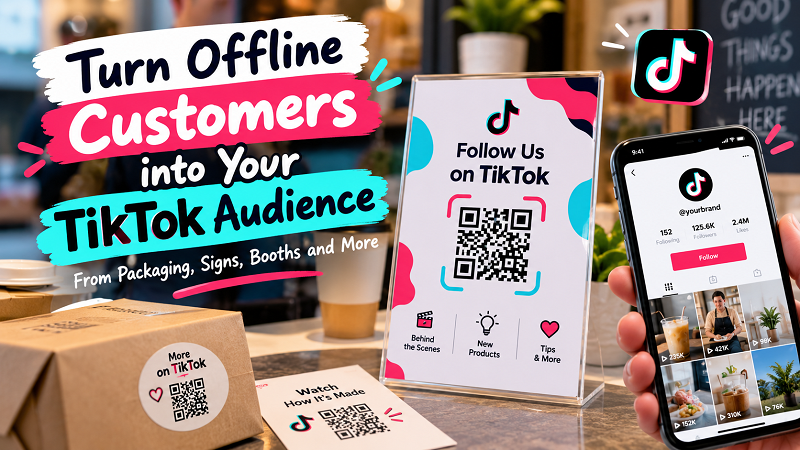
The Offline Audience Is Easy to Forget
Most TikTok growth advice assumes the audience is already online. Post consistently. Follow trends. Improve your hooks. Respond to comments. Collaborate with creators.
All useful ideas, but they overlook another group: people who discover your business somewhere else.
They might meet you at a local store, a trade show, a farmers market, a pop-up event, a restaurant, a classroom, or a product display. They may already be interested because they have physically interacted with your business.
That's valuable attention.
The awkward part is that TikTok doesn't always make the transition from an offline interaction to an online account particularly memorable. Saying “find us on TikTok” puts the work on the customer.
A simple scan can remove that extra effort.
Don't Put Your Username on Everything and Call It a Strategy
Printing your TikTok username on packaging or a sign is better than saying nothing, but it still assumes people will manually search for you.
There's another issue: usernames aren't always as recognizable as brand names. They can contain numbers, abbreviations, underscores, unusual spelling, or a variation of the business name that made sense when the account was created.
Imagine seeing a package that says:
Follow us on TikTok: @brandname_official23
Technically, the information is there.
Practically, most customers are not going to memorize it.
A QR code turns that same instruction into an action. Instead of remembering the username, the customer can scan and arrive at the intended destination.
Think About Where the Customer Is Standing
The best placement isn't necessarily where you have the most empty space.
Think about the moment when someone is most likely to care.
A coffee shop could place a small QR code near the pickup counter. A clothing brand could include one on a product insert. A restaurant might put one on a table card. A creator selling products at an event could display one at the booth.
The common thread is context.
If someone has just purchased something, that's a natural moment to discover behind-the-scenes videos or new product content. If someone is waiting in line, they have time to look at a sign. If someone is attending a workshop, a QR code can become an easy bridge to the creator's content after the event.
You don't need to plaster a QR code across every surface. Put it where interest already exists.
Decide What Should Happen After the Scan
This sounds obvious, but it's one of the easiest things to overlook.
Where exactly should the QR code take people?
For most businesses, the TikTok profile is the logical destination because it gives the visitor a chance to see more content and decide whether the account is worth following.
But the right destination depends on the campaign.
If you're promoting a particular product launch, a specific video might make more sense. If you're running a recurring content series, your profile could provide better context. If the goal is to encourage people to watch a tutorial, sending them directly to that content reduces another layer of navigation.
The destination should match the promise printed next to the QR code.
If your sign says “Watch Our New Product Video,” don't send someone on a scavenger hunt through your entire profile.
Your CTA Matters More Than You Think
A QR code sitting alone on a piece of paper doesn't explain itself.
Give people a reason to use it.
Instead of:
TikTok
Try something that describes the benefit:
Watch how we make it
See what's happening behind the scenes
Follow our latest drops
More recipes on TikTok
Watch the full video
The best wording depends on what you're actually offering. A restaurant, fashion brand, creator, and software company shouldn't all sound identical.
The QR code handles the technical shortcut. The CTA handles the human part.
Packaging Is an Underrated TikTok Touchpoint
Product packaging can keep working after the customer has left your store.
Someone opens a package at home. They see a short message and a QR code. Maybe the brand has a funny behind-the-scenes series, product tutorials, recipes, styling ideas, or new-release announcements on TikTok.
That's a very different experience from asking the customer to remember a username several hours earlier.
A small insert inside the package can work in the same way. This is particularly useful when the physical product and TikTok content naturally belong together.
For example, a food brand might invite customers to see recipe ideas. A clothing company could showcase styling videos. A beauty brand could point customers toward tutorials. A maker could show how the product is produced.
The key is giving the customer something worth seeing rather than simply asking for another follow.
Make the QR Code Part of the Design
There is a temptation to treat QR codes as something that gets added at the very end.
Design the poster first. Finish the packaging. Print the menu. Oh, right — we need a QR code.
That approach often produces the familiar giant square awkwardly squeezed into whatever space remains.
Instead, treat the QR code as one small component of the overall layout.
Give it breathing room. Keep enough contrast. Make the accompanying text readable. Don't place it directly against a complicated photograph. And don't make it so tiny that people need to squint at the packaging to find it.
The code doesn't need to dominate the design. It just needs to be easy to notice and easy to scan.
Test It Like a Customer Would
Before printing 5,000 product inserts or putting a giant sign in your storefront, test the complete experience.
Stand several feet away from the sign. Can you identify what the QR code is for?
Scan it with a normal phone. Does it open the intended TikTok destination?
Try it under different lighting. Test the printed version rather than relying entirely on your design file.
Then ask someone who wasn't involved in creating the campaign to scan it. If they hesitate and ask, “What does this do?”, your CTA probably needs work.
That tiny usability test can save you from discovering the problem after everything has already been printed.
Don't Measure the QR Code by Follower Count Alone
A QR campaign can have value even if every person who scans doesn't immediately follow the account.
Some visitors may watch a video and leave. Others may return later. Someone might discover your content today and become a customer weeks from now.
Of course, follows can be a useful metric when they align with the goal of the campaign. But the larger objective is creating a smooth connection between an offline interaction and your online content.
The QR code is simply the bridge.
Turn “Find Us on TikTok” Into an Actual Experience
Your customers don't need another username to remember.
They need a clear reason to take the next step and an easy way to do it. If someone is already standing in your store, holding your product, visiting your booth, or reading your printed material, you've already earned a few seconds of their attention. Don't waste those seconds making them search.
A well-placed tiktok qr code can turn that offline moment into a direct path to your content, especially when the destination, CTA, placement, and surrounding design all work together.
The goal isn't to make every physical surface interactive. It's to remove one unnecessary step for people who are already interested.