A customer walks into your store, looks around, picks up a product, asks a question, checks out, and leaves. That entire journey might take ten minutes. Yet somewhere inside those ten minutes, there could be several natural opportunities to introduce your TikTok content.
- Your Store Already Has Attention. Use It Better.
- Find the Moment When TikTok Makes Sense
- Stop Saying “Follow Us” Without Explaining Why
- Give Different Areas of the Store Different Jobs
- Let the Content Do Some of the Selling
- Think in Content Series, Not One-Off Videos
- Where Should You Put the Code?
- Keep the Scan Experience Simple
- A Simple Way to Build a TikTok QR Touchpoint
- Measure What Happens After the Scan
- Turn a Store Into a Content Touchpoint
The problem is that simply putting a TikTok logo and a QR code near the checkout counter does not automatically create engagement. Customers need a reason to scan, and that reason has to make sense in the moment.
That is where a QR code can become more than a shortcut to a social profile. Used thoughtfully, it can turn a physical store into an entry point for your short-form video content, giving customers something useful, entertaining, or timely to explore before they walk away.
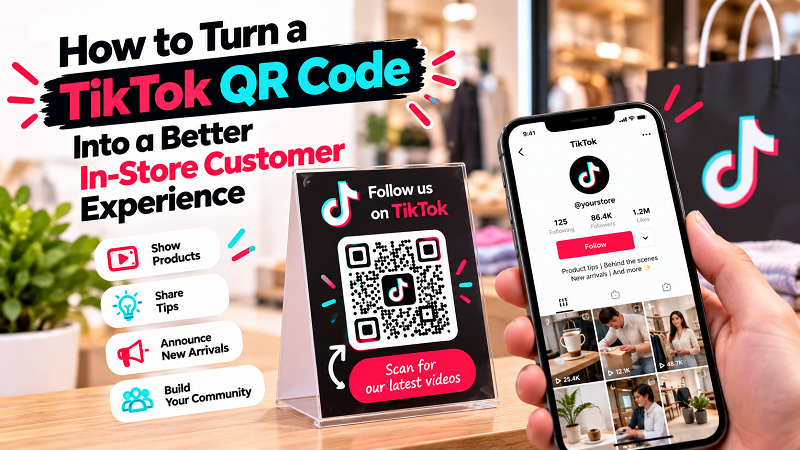
Your Store Already Has Attention. Use It Better.
Physical stores have something social media marketers spend enormous amounts of effort trying to obtain: people who are already paying attention.
A customer examining a product is already curious. Someone waiting for an order has time to spare. A person standing at the checkout counter has just completed a purchase. Someone browsing a display may be looking for ideas before making a decision.
These moments are valuable because the customer does not need to be convinced to enter the store. They are already there.
Instead of treating TikTok as something completely separate from the physical shopping experience, think of it as another layer of that experience. The right video can answer a question, demonstrate a product, introduce a new arrival, or simply give the customer a reason to stay connected with the brand.
The trick is matching the content with the moment.
Find the Moment When TikTok Makes Sense
Not every customer interaction is a good opportunity for a social CTA. Timing matters.
Before a purchase, TikTok content can help customers discover products or see how something works. This can be particularly useful when shoppers are comparing options and want a quick demonstration rather than a long sales pitch.
While customers are waiting, short-form content can turn dead time into discovery. A café, salon, restaurant, clinic, showroom, or service counter may have several minutes when customers are simply standing or sitting around.
After a purchase, the objective can change. Instead of helping someone decide what to buy, the content can help them get more value from what they already purchased. Product tips, care instructions, recipes, styling ideas, tutorials, and behind-the-scenes videos can all work here.
The QR code stays the same type of technology. The reason for scanning changes with the customer journey.
Stop Saying “Follow Us” Without Explaining Why
“Follow us on TikTok” is a perfectly reasonable request. It is also incredibly easy to ignore.
Customers are constantly being asked to follow brands, subscribe to newsletters, download apps, leave reviews, and join loyalty programs. Another generic “follow us” message does not give them much motivation.
A stronger approach is to connect the follow with something concrete.
Try positioning the content around a benefit:
- See what's new this week.
- Watch how we make it.
- Get quick product tips.
- See our latest arrivals.
- Watch behind the scenes.
- Follow for weekly ideas.
Now the QR code has context. The customer knows what they are about to get instead of being asked to follow a social account simply because the business has one.
That small change can make the physical-to-digital transition feel much more natural.
Give Different Areas of the Store Different Jobs
One QR code does not have to serve the entire store.
Consider a retail environment with several customer touchpoints. The entrance could introduce the brand's latest content. A product display could lead to videos demonstrating that specific product category. The checkout area could promote new arrivals or upcoming promotions. A shopping bag could invite customers to follow for future product ideas.
This creates a more interesting relationship between the physical environment and the content library.
The important part is keeping the message relevant. A QR code beside a blender should not send someone to a random collection of unrelated videos. A customer looking at skincare products should not have to scroll through months of general company updates before finding something useful.
Context earns the scan.
Let the Content Do Some of the Selling
One advantage of short-form video is that it can demonstrate things that are difficult to communicate through a shelf label.
A product might look ordinary until a customer sees it being used. A food item might become more appealing after watching a quick serving idea. A piece of clothing can look completely different when shown in an actual outfit. A handmade product can gain personality when customers see the process behind it.
This makes TikTok especially interesting for businesses that sell products where demonstration, personality, or visual storytelling matters.
Instead of saying, “This product is great,” the content can show why.
And that distinction is important. The QR code should not merely transport people to promotional material. It can open a small piece of the brand experience that makes the physical product more memorable.
Think in Content Series, Not One-Off Videos
There is another reason to connect an in-store QR experience with TikTok: repeat visits.
If every QR code leads to a single video that never changes, the experience may become stale. But if the content is part of an ongoing series, customers have a reason to return.
A restaurant could regularly feature new dishes. A fashion store could showcase weekly outfit combinations. A beauty business could publish recurring tips. A specialty retailer could share product demonstrations, customer favorites, or seasonal recommendations.
This turns TikTok from a static destination into an evolving content channel.
The physical QR code stays in place while the reason to visit the destination can continue changing.
That is a much more interesting use of printed media than simply placing a permanent social icon on a counter.
Where Should You Put the Code?
Placement should follow customer behavior rather than design convenience.
A checkout counter works because customers naturally pause there. Product displays work when the content helps with a purchase decision. Packaging works after the transaction, when customers have already committed to the product. Waiting areas can work particularly well because people have time and are often looking for something to do.
Shopping bags are another interesting surface because they travel beyond the store. A customer may scan immediately, later at home, or even show the bag to someone else.
The best location is therefore not necessarily the most visible one. It is the place where the QR code makes the most sense at the exact moment someone sees it.
A giant QR code with no context can be less effective than a smaller, well-positioned code accompanied by a clear reason to scan.
Keep the Scan Experience Simple
Once someone decides to scan, don't make the next step complicated.
The destination should open cleanly on a phone. The customer should immediately recognize the account or content they were promised. The profile should look active and credible, and the most relevant content should not be buried beneath unrelated posts.
It is also worth checking the physical code itself. Test it from the distance at which customers will actually encounter it. Try different phones and lighting conditions. If the code is printed on packaging, test the real packaging rather than a flat design mockup.
Small physical details can make a surprisingly large difference.
A Simple Way to Build a TikTok QR Touchpoint
The process can be kept straightforward.
Start with the TikTok profile or destination you want customers to reach. Copy its shareable link and generate a QR code from that URL. Once the code is ready, place it alongside a short CTA that explains the benefit of scanning.
If you're creating a qr code tiktok, don't stop after checking whether your phone recognizes the pattern. Test the entire experience: scan it, open the destination, look at the profile as if you were a first-time visitor, and ask whether the content matches the message printed next to the code.
That final perspective is useful because businesses tend to evaluate QR codes from the owner's point of view. Customers experience them differently.
Measure What Happens After the Scan
A QR code on a counter may get plenty of scans and still fail to create meaningful engagement.
Look beyond the initial interaction. Depending on your goal, useful signals can include profile visits, video views, followers, repeat engagement, or traffic generated by the campaign.
For example, if the goal is to introduce new products, video views and subsequent product interest may matter more than follower count. If the goal is long-term audience building, profile visits and follows may become more relevant.
There is no single metric that makes every QR campaign successful. The metric should reflect the reason the code exists in the first place.
Turn a Store Into a Content Touchpoint
The most interesting part of connecting TikTok with a physical store is not the technology. QR codes have been around for years, and generating one is hardly the difficult part.
The opportunity is in designing a better transition between two environments.
A customer is standing in your store. They are already looking, thinking, comparing, waiting, or buying. Give them something relevant to do next.
Maybe it is a product demonstration. Maybe it is a quick tip. Maybe it is a new collection. Maybe it is a glimpse behind the scenes. Maybe it is simply entertaining content that makes the brand feel more human.
When the reason is clear, the QR code stops looking like another piece of promotional clutter.
It becomes an invitation.
And that is the difference between putting a TikTok QR code in your store and actually making TikTok part of the customer experience.