- Getting Attention Is Easy. Earning a Client’s Trust Is Harder.
- What Clients Need to Know Before Hiring an Independent Professional
- The Credibility Gap Between a Portfolio and a Real Person
- Make Professional Verification Easier Without Turning It Into a Sales Pitch
- Where a LinkedIn QR Code Fits Into a Freelancer’s Client Journey
- Trust Comes From Consistency, Not Just a QR Code
Landing a potential client’s attention is one thing. Giving them enough confidence to hire you is a completely different challenge. As a freelancer, you might have an impressive portfolio, a polished proposal, and years of relevant experience, yet a prospective client may still hesitate before committing to a project. Why? Because clients are not simply buying your skills. They are also deciding whether they can trust the person behind the work.
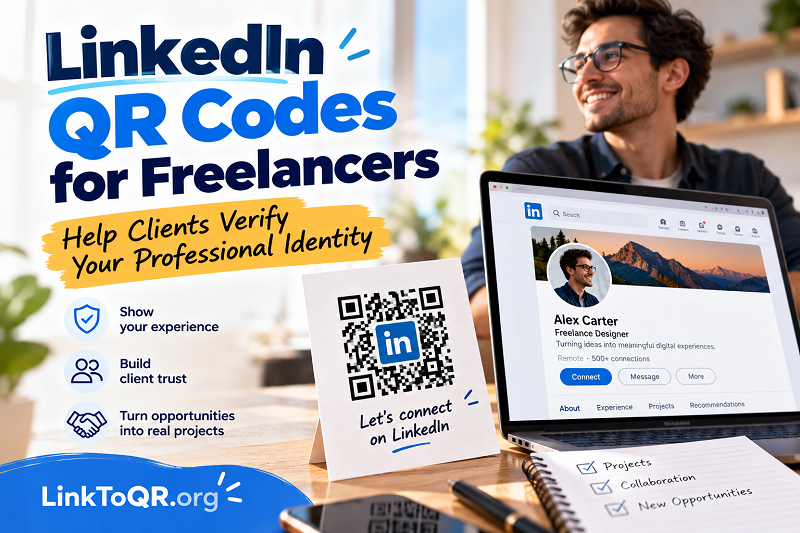
That’s where professional credibility becomes a competitive advantage. Making your background easier to explore, your experience easier to understand, and your professional identity easier to verify can help remove unnecessary friction from the hiring process. A LinkedIn QR code is one practical way to connect your offline introductions and business materials with your professional presence online.
Getting Attention Is Easy. Earning a Client’s Trust Is Harder.
Freelancers compete in a market where clients often have dozens of people to choose from. A designer may showcase beautiful mockups, a developer may demonstrate sophisticated projects, and a consultant may present a compelling business proposal. But impressive work samples do not automatically answer every question a client has about the person delivering them.
Who actually completed the work? Does this professional have experience relevant to the project? Can the client learn more about their background without starting another lengthy conversation? These questions matter even more when the relationship begins remotely or involves a significant financial commitment.
The problem is not necessarily a lack of talent. Sometimes, the information needed to evaluate that talent is scattered across a portfolio website, email signature, résumé, social media account, and previous conversations. Every additional search creates another opportunity for a potential client to lose interest or postpone a decision.
Smart freelancers make the evaluation process straightforward. Instead of asking prospects to piece together their professional story, they give them a clear path to the information that matters.
What Clients Need to Know Before Hiring an Independent Professional
Hiring a freelancer involves a degree of uncertainty. Unlike working with an established company, a client may have limited information about an independent professional before the first project begins. A strong introduction should help answer several important questions without overwhelming the reader.
First, what do you actually do? A clear professional headline and concise description of your expertise help clients quickly understand whether you fit their needs. Being specific about your services is generally more useful than presenting yourself as someone who can do everything.
Second, is your experience relevant? Clients want to see evidence that connects your background to their challenges. Relevant projects, clearly described responsibilities, recommendations, and professional achievements can provide useful context. The goal is not to overwhelm prospects with every accomplishment you have ever collected. It is to help them understand why your experience matters to their particular project.
Third, can they find the right information quickly? A potential client should not have to search through multiple accounts just to identify your professional profile. Consistent names, recognizable branding, and accessible links make it easier to connect your introduction with your online presence.
These details may seem small individually, but together they shape how easy you are to evaluate. Professional trust rarely comes from one impressive claim. It develops when the information you provide is clear, relevant, and consistent.
The Credibility Gap Between a Portfolio and a Real Person
A portfolio proves that certain work can be presented. It does not always explain the complete story behind that work. Some projects involve teams, some are completed under confidentiality agreements, and others showcase only a small portion of a freelancer’s responsibilities. Without context, clients may struggle to understand what the professional actually contributed.
Your LinkedIn profile can complement a portfolio by providing a broader view of your professional background. Depending on what you have included, visitors may be able to explore your work history, skills, recommendations, education, and professional connections. This additional context can help them build a more complete picture of your experience.
However, there is an important distinction: an accessible profile is not the same as independently verified credentials. A LinkedIn profile does not automatically prove every claim it contains. For higher-stakes projects, clients may still need references, work samples, interviews, or other relevant evidence.
Your objective is to make the first stage of that evaluation easier, not to promise instant credibility. A well-maintained profile, supported by relevant evidence, gives prospective clients a more useful starting point than a vague introduction and a collection of disconnected links.
Make Professional Verification Easier Without Turning It Into a Sales Pitch
Nobody wants to feel pressured into hiring someone after scanning a code or opening a business card. The best professional introductions give people room to explore, evaluate, and decide for themselves. Your materials should make that process convenient without making exaggerated promises.
Start by checking the consistency of your professional identity. Use a recognizable name, a clear description of your services, and a professional photograph that matches the image you present elsewhere. Review your work history and featured content to ensure they reflect your current expertise. Remove outdated details that could confuse potential clients.
Next, think about the questions your ideal client is likely to ask. If you are a freelance designer, relevant projects may matter most. If you provide consulting services, your industry experience and the problems you solve may deserve greater attention. A generic profile can communicate that you are active professionally, but a thoughtfully organized one gives prospects more useful reasons to continue the conversation.
Finally, make your profile easy to reach. A direct link in your email signature, proposal, or portfolio can work well online. For printed materials or face-to-face introductions, a QR code can provide another convenient access point. The technology is simple; the real value comes from directing people toward information that genuinely helps them evaluate your services.
Where a LinkedIn QR Code Fits Into a Freelancer’s Client Journey
A QR code is most useful when it solves a real access problem. It should appear where someone has a reasonable reason to learn more about you, rather than being added to every document simply because the technology is available.
In proposals sent to new clients, a QR code can offer a convenient way to explore your professional background after reading your pitch. Keep the proposal focused on the client’s needs, and let your profile provide supporting context instead of repeating your entire résumé.
During in-person introductions, a printed business card or portfolio may reach someone who wants to reconnect later. A scannable code can help bridge that moment with your online professional identity, reducing the need to search for your name manually.
On printed portfolios and presentation materials, the code can give prospective clients another route to your professional profile after a meeting or presentation. Make sure it is large enough to scan comfortably, has sufficient contrast, and is tested on a real device before printing multiple copies.
For these situations, a linkedin qr generator can turn your LinkedIn profile URL into a scannable QR code that you can incorporate into suitable materials. Choose a destination that makes sense for your audience, test the finished code, and confirm that your profile is accessible to the people you expect to scan it.
Remember that a QR code is an access tool, not a substitute for professional substance. It cannot repair an incomplete profile, establish expertise on its own, or guarantee that a prospect will become a client. Its job is to remove a small but unnecessary obstacle between someone’s interest and the information they need.
Trust Comes From Consistency, Not Just a QR Code
Freelancers do not need to turn every interaction into a personal branding campaign. They need to make it easy for the right clients to understand what they do, assess the evidence, and decide whether a working relationship makes sense.
Start with the fundamentals: maintain an accurate professional profile, present relevant work clearly, keep your contact information consistent, and make supporting information easy to access. Then use tools such as QR codes where they naturally improve the experience, whether that means sharing a portfolio during a meeting or connecting a printed proposal with your online presence.
Most importantly, remember that credibility is built through consistency between what you promise and what you deliver. A professional profile may encourage a client to take a closer look, but your communication, expertise, reliability, and actual work will determine whether that initial interest develops into a lasting business relationship.
Make it easier for clients to learn about you, give them meaningful evidence to consider, and let your professionalism do the heavy lifting.