A business opens its second location. Then a third. Maybe there are five stores now, each with its own counter, signage, packaging, receipts, and promotional materials.
- The One-QR Approach: Simple and Consistent
- But What If Every Location Has a Different Story?
- One Destination Doesn't Always Mean One QR
- When One QR Is the Better Fit
- When Separate QR Codes Start Making Sense
- A Quick Decision Framework
- Don't Make the CTA Do Too Much
- What About a Business With Ten Locations?
- Think About the Printed Material's Lifespan
- The Customer Shouldn't Have to Understand Your QR Strategy
- A Practical Example
- Store A: Everyday customer traffic
- Store B: Local promotion
- Store C: Event location
- Build the System Around the Customer Journey
- Keep It Simple Until Complexity Has a Job
But there is still only one Facebook Page.
That creates a surprisingly simple question with a less obvious answer: Should every location use the same QR code, or should each location have its own?
There isn't one setup that fits every business. The right choice depends on what you want people to do after scanning, how different your locations are, and whether you need to understand the journey behind each printed QR.
The important thing is to stop thinking about the QR as a piece of artwork and start thinking about it as a small bridge between a physical location and a digital destination.
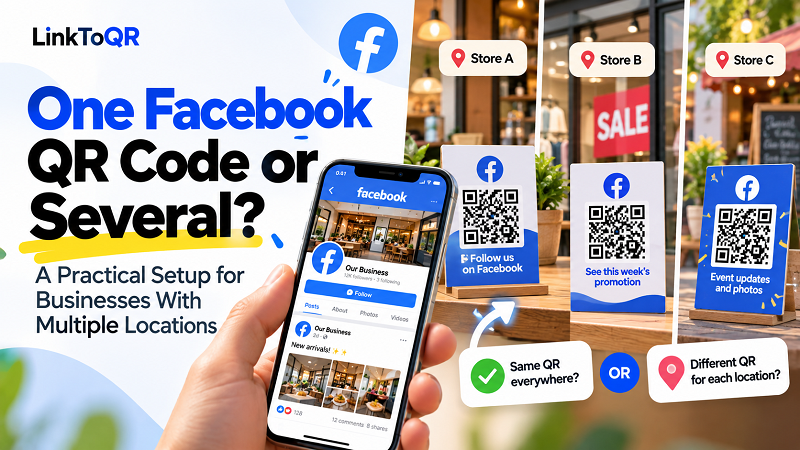
The One-QR Approach: Simple and Consistent
Imagine a retail brand with three stores across the same city. All three locations use the same Facebook Page, publish the same brand content, and want customers to follow the business rather than communicate with individual stores.
In that situation, one QR code can make perfect sense.
The same code can appear on:
- Store signage
- Counter displays
- Shopping bags
- Printed cards
- General promotional materials
There is a nice operational advantage here: everything stays simple.
The marketing team has one destination to maintain. Staff members don't have to remember which QR belongs to which store. Existing materials can be reused more easily, and customers get the same brand destination regardless of where they encounter the code.
For a straightforward “find us on Facebook” journey, simplicity can be a feature rather than a limitation.
But What If Every Location Has a Different Story?
Now change the scenario.
Store A is launching a new product. Store B is running a weekend promotion. Store C is hosting a local event. The business still has one main Facebook Page, but the physical experiences are no longer identical.
Suddenly, using the exact same QR everywhere becomes less attractive.
A customer standing inside Store B doesn't necessarily have the same reason to scan as someone visiting Store A. The physical context has changed, even though the brand's Facebook destination hasn't.
This is where separate QR codes can become useful.
The destination doesn't necessarily need to be a completely different Facebook Page. The important difference can be the role of each QR within the campaign.
One location might use a QR to connect customers with a specific announcement. Another might use one alongside a local promotion. A third could simply use the main brand destination.
The QR strategy starts reflecting the physical environment instead of treating every location as interchangeable.
One Destination Doesn't Always Mean One QR
This distinction is easy to miss.
You can have:
One Facebook Page + one QR code
or:
One Facebook Page + multiple QR codes
Those are not the same setup.
The first treats every physical placement as essentially identical.
The second allows different printed placements to have different purposes, even when they ultimately connect to the same broader brand presence.
Think of it like this: a hotel might have one website but different links printed on a room card, restaurant menu, conference sign, and front-desk display. The brand destination is shared, but the context surrounding each link is different.
A QR can work the same way.
When One QR Is the Better Fit
Consider a business where the main objective is simply to make its Facebook presence easier to find.
The customer sees:
“Follow us on Facebook.”
They scan.
They arrive at the brand's Facebook presence.
Done.
There is no need to make the system more complicated than the customer journey requires.
One QR is particularly straightforward when:
- All locations promote the same Facebook presence
- The CTA is identical everywhere
- There are no location-specific campaigns
- Marketing doesn't need to distinguish individual placements
- Printed materials are shared across locations
The biggest advantage isn't technical. It's operational clarity.
Everyone knows which code to use, and there are fewer things that can go wrong during printing or distribution.
When Separate QR Codes Start Making Sense
Now imagine a chain with very different locations.
A downtown store serves office workers. A shopping-center store attracts families. Another location operates mainly around events and seasonal traffic.
The brand may still have one Facebook Page, but the marketing objectives can vary significantly.
Separate QR codes become more interesting when you want to distinguish:
Location
Where was the customer when they encountered the QR?
Campaign
Which promotion or message introduced the QR?
Context
Was the person looking at packaging, a receipt, a poster, or a counter display?
Customer journey
What did the business expect the customer to do after scanning?
This doesn't automatically mean every location needs its own QR. It means there is now a reason to consider separating the physical touchpoints.
A Quick Decision Framework
Instead of asking, “Should we have one QR or five?” start with four questions.
| Question | If the answer is yes | If the answer is no |
|---|---|---|
| Is the CTA identical everywhere? | One QR may be enough | Consider separate codes |
| Do all locations have the same customer journey? | One QR may be enough | Separate by context |
| Do campaigns differ by location? | Separate codes can help | One QR remains practical |
| Do you need to distinguish physical placements? | Separate codes are useful | Keep the setup simple |
This approach prevents a common mistake: creating multiple QR codes simply because multiple locations exist.
More codes do not automatically create more value.
The codes should exist because the customer journeys are meaningfully different.
Don't Make the CTA Do Too Much
The words next to a QR code have a bigger job than they might appear to.
Compare these two messages:
Scan to connect with us
and
Scan to see what's happening at this location
They create different expectations.
The first is broad. The second suggests local relevance.
This becomes especially important when several stores share one Facebook Page. If customers expect location-specific information but arrive at a general brand destination, the experience can feel disconnected.
Before choosing your QR structure, decide what the printed message is promising.
Then make sure the destination supports that promise.
What About a Business With Ten Locations?
At ten locations, the temptation may be to create ten completely separate QR systems.
Pause there.
A larger number of locations doesn't automatically mean a more complicated QR strategy is necessary.
Ask whether the locations genuinely need different customer journeys.
If ten stores all use identical signage, identical messaging, and the same Facebook destination, maintaining ten different codes may create unnecessary operational work.
But if each location runs its own campaigns, serves a different audience, or uses different printed materials, separate QR codes may provide a more useful structure.
The number of locations is therefore not the deciding factor.
The number of distinct customer journeys is.
Think About the Printed Material's Lifespan
There is another detail that often gets ignored: printed materials don't disappear when a campaign ends.
A social promotion might run for two weeks. A poster might remain on a wall for three months. Packaging could stay in circulation much longer.
That creates a mismatch if the QR destination is designed around a short-lived message.
For example, a poster saying:
“Scan for this weekend's Facebook promotion”
has a very different lifespan from:
“Follow our Facebook Page for updates.”
The first is campaign-specific. The second is evergreen.
The longer the printed material is expected to remain visible, the more carefully you should consider whether the destination will still make sense later.
The Customer Shouldn't Have to Understand Your QR Strategy
Here's the funny thing about all this planning: customers don't care whether you use one QR code or twenty.
They shouldn't have to.
They see a message. They scan. They expect the next step to make sense.
That's why the internal structure should remain invisible from the customer's perspective.
A customer at Store A doesn't need to know that Store B has a different QR. They only need the code in front of them to lead somewhere relevant to the message they just read.
Good QR architecture is almost boring from the outside.
The complexity belongs behind the scenes.
A Practical Example
Let's say a three-location retailer wants to grow its Facebook presence.
Store A: Everyday customer traffic
The sign says:
Follow us on Facebook for new arrivals and updates.
A general brand destination makes sense.
Store B: Local promotion
The sign says:
Scan to see this week's store promotion.
A campaign-specific destination may make more sense here.
Store C: Event location
The sign says:
Scan to see event updates and photos.
The destination should support that specific context rather than forcing visitors to browse the entire Facebook presence looking for relevant information.
Notice what changed.
The brand didn't suddenly need three Facebook Pages.
It needed three different answers to the question:
What should this customer see after scanning this particular QR?
That is the more useful question to ask.
Build the System Around the Customer Journey
If you're deciding how to structure a qr facebook page strategy across multiple locations, don't begin with the number of codes.
Begin with the journey.
Physical location → printed message → scan → destination → desired action
If that journey is identical everywhere, keeping the QR setup simple is often logical.
If the journey changes significantly from one location or campaign to another, separate codes can give you more flexibility.
Either way, the QR should serve the experience rather than becoming the experience itself.
Keep It Simple Until Complexity Has a Job
There is a natural tendency to assume that a more sophisticated QR setup must be better.
Not necessarily.
A business with three identical stores and one clear Facebook goal may be perfectly well served by one QR code.
A business with ten locations, multiple campaigns, different physical experiences, and a need to distinguish customer journeys may have a genuine reason to use several.
The goal isn't to maximize the number of QR codes.
The goal is to make every scan make sense.
Once you look at QR codes that way, the decision becomes much easier: one code when the experience is the same, separate codes when the experience is meaningfully different.