- The Two Seconds Before a Scan Can Make or Break Your Campaign
- What Makes a QR Code Feel Suspicious?
- No Explanation, No Motivation
- Branding That Doesn't Match the Destination
- Unexpected Requests for Personal Information
- Trust Is Built Before, During, and After the Scan
- Before the Scan: Make the Purpose Obvious
- During the Scan: Let People Check the Destination
- After the Scan: Deliver What You Promised
- A Beautiful QR Code Is Not the Same as a Trustworthy Experience
- A Better Way to Evaluate Your QR Code Campaign
- Stop Asking People to Scan. Give Them a Reason to Want To.
Your QR code is sharp. The design looks professional. You placed it right where people can see it, and the link works perfectly. So why are people walking past it like it owes them money?
Here’s the uncomfortable truth: a QR code can work flawlessly and still fail to get scanned. Technical functionality is only one part of the equation. Before someone points a phone at that little square, they need a reason to care, a clear idea of what happens next, and enough confidence to take the risk.
For businesses, marketers, event organizers, and anyone using QR codes to connect offline audiences with online content, this distinction matters. You are not simply asking people to scan an image. You are asking them to trust a shortcut they cannot fully inspect at a glance. And if that shortcut feels confusing, suspicious, or pointless, even the most polished design won't save the campaign.
The Two Seconds Before a Scan Can Make or Break Your Campaign
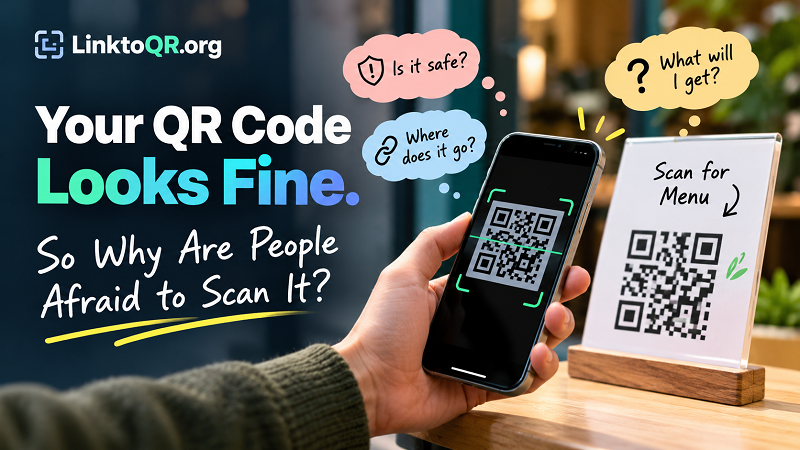
Imagine walking into a restaurant and spotting a QR code on the table. There is no explanation, no brand name, and no indication of what the code does. Is it a menu? A payment page? A survey? A promotional offer that requires your email address?
You have questions. The restaurant has provided absolutely zero answers. So you keep scrolling on your phone or ask the server for a physical menu.
Now imagine the same code with a simple message: “Scan to Explore Our Menu.” Suddenly, the purpose is obvious. You know what you're getting before you commit.
That small difference highlights three factors behind scanning behavior:
- Motivation: Does the person have a reason to scan?
- Clarity: Can they predict what the code will lead to?
- Trust: Do they feel comfortable opening the destination?
These factors work together, but they are not interchangeable. A discount might create motivation, while a recognizable brand builds confidence. Clear instructions remove uncertainty. Ignore any one of these elements, and you may lose people before the camera even opens.
What Makes a QR Code Feel Suspicious?
QR codes are convenient precisely because they hide a long web address inside a compact visual pattern. But that convenience comes with a trade-off: people cannot reliably tell where a code leads just by looking at it.
Scammers can exploit this uncertainty by placing malicious QR codes on fake parking notices, fraudulent payment requests, misleading emails, or stickers covering legitimate codes. The FBI and the Federal Trade Commission have both warned consumers about QR-code-related scams and the importance of checking destinations before proceeding.
Not every unfamiliar QR code is dangerous, of course. Still, people have good reasons to be cautious. Your job as a legitimate business is not to eliminate healthy skepticism. It is to give people enough context to make an informed decision.
No Explanation, No Motivation
A bare QR code forces the audience to do the thinking. People must guess what the scan will deliver and decide whether the potential reward is worth the effort. Most won't bother unless the surrounding context makes the benefit obvious.
Replace vague prompts such as “Scan Here” with specific, outcome-focused messages. “Download the Product Guide,” “View Today's Menu,” or “Get Your Event Photos” tells people exactly why the code exists. The more relevant the promise, the easier it becomes to understand the value of scanning.
Branding That Doesn't Match the Destination
Picture a QR code printed on a coffee shop's official menu. The code opens an unfamiliar domain with no recognizable branding. Even if the destination is legitimate, the sudden disconnect can raise questions.
Consistent branding helps people recognize the business behind the experience. Use your logo where appropriate, identify the organization responsible for the code, and make sure the landing page reinforces that identity. Branding is not a security guarantee, but it can reduce unnecessary confusion.
Unexpected Requests for Personal Information
Someone scans a code expecting a menu and lands on a page demanding their phone number, email address, and date of birth. That's a pretty aggressive first date.
If a landing page requests information that has little to do with the promised benefit, users may abandon it immediately. Ask only for information that is genuinely necessary, explain why you need it, and avoid surprising visitors with unexpected forms or permissions.
Trust Is Built Before, During, and After the Scan
Instead of treating QR codes as isolated marketing assets, think of them as the entrance to a three-stage experience. Every stage gives users another reason to continue—or another reason to leave.
Before the Scan: Make the Purpose Obvious
The printed code is not your entire message. Its surroundings do part of the selling.
On packaging, explain what additional information the code provides. At an event, tell attendees whether they will find the schedule, speaker profiles, or presentation slides. In a retail store, connect the code to a specific benefit, such as product details or available sizes.
If you need to create the code for a web destination, a tool that helps you make a qr code from a link can turn a URL into a scannable QR code. But choose the destination first, then build the message around what people will actually receive. The technology handles the connection; your communication gives people a reason to use it.
During the Scan: Let People Check the Destination
People should be able to approach a QR code without feeling pressured into opening an unknown website. Encourage sensible habits: inspect the displayed URL, check for misspelled domains, and be cautious when a link requests payment credentials or other sensitive information unexpectedly.
For businesses, transparency starts with using the correct destination and avoiding unnecessary redirects. A short, recognizable domain can be easier to understand than a confusing chain of unfamiliar addresses. If you use a third-party service, make sure the resulting experience remains consistent with the promise made beside the code.
Remember, a professional appearance does not prove that a QR code is safe. Users should still verify the destination, especially before entering sensitive information or making a payment.
After the Scan: Deliver What You Promised
This is where many otherwise promising campaigns lose momentum. The customer scans a code expecting a quick answer, but the page loads slowly, displays badly on a phone, or buries the useful information beneath pop-ups and promotional clutter.
Your landing page should fulfill the promise immediately. If the CTA says “View the Menu,” show the menu—not a generic homepage that requires another three clicks. If the code promises a product guide, put the guide within easy reach.
Mobile usability matters because scanning typically happens on a phone. Keep text readable, buttons easy to tap, and the primary action obvious. Remove unnecessary steps, test the page on different devices, and check that the destination still works after you print and distribute the code.
A Beautiful QR Code Is Not the Same as a Trustworthy Experience
It's tempting to focus on colors, custom shapes, logos, and decorative frames because those elements are easy to see. Visual design can help a code fit your brand, attract attention, and stand out from its surroundings. However, good looks cannot compensate for a broken link or a questionable destination.
A few practical distinctions are worth remembering:
Design improves recognition, not guaranteed security. A branded code can look convincing even when its destination has been compromised or replaced. Verify the URL and protect the physical placement of printed codes.
Static and dynamic QR codes serve different purposes. A static QR code stores its destination directly in the pattern, while a dynamic QR service typically uses an intermediate link that can support destination changes and additional tracking features. Neither format is automatically safer. Security depends on the actual destination, the service, and how the code is managed.
A working link does not guarantee a good landing page. The URL may load correctly while delivering an irrelevant, confusing, or frustrating experience. Test the entire journey, not just whether the code scans.
More tracking does not always mean better marketing. Collect only the analytics you need, respect applicable privacy requirements, and be transparent about data collection. A campaign should build customer confidence rather than quietly undermine it.
A Better Way to Evaluate Your QR Code Campaign
Forget judging success by how many codes you print or how attractive they look on a poster. Those numbers describe your output, not necessarily the audience's response.
Instead, evaluate the campaign through three questions.
1. Do people understand the value before scanning? Review the CTA, placement, and surrounding message. Ask someone unfamiliar with the campaign what they expect to find after scanning. If their answer differs from your intended outcome, your message needs work.
2. Can users recognize and verify the destination? Check that the URL is correct, the landing page matches the brand, and the destination does not introduce unnecessary surprises. For public-facing codes, inspect the physical placement periodically to catch damaged, altered, or suspiciously overlaid stickers.
3. Does the experience fulfill the promise? Test the journey on real phones, including the network conditions and devices your audience is likely to use. Confirm that the primary content appears quickly and that visitors can complete the intended action without unnecessary friction.
If analytics are available, look beyond scan counts. Depending on your setup, you may be able to compare scans with landing-page visits, completed registrations, downloads, purchases, or other meaningful actions. A large number of scans with few completed actions could point to a mismatch between the CTA and the landing page, usability problems, or an audience that was curious but not genuinely interested. Use the surrounding evidence before deciding what caused the drop-off.
You can also ask a small sample of customers what made them scan—or ignore—a particular code. Their answers may reveal problems that click data cannot explain, such as unclear wording, an unconvincing offer, or a lack of context.
Stop Asking People to Scan. Give Them a Reason to Want To.
A QR code is a bridge between the physical world and a digital destination. But bridges only work when people feel confident crossing them and can see why the journey is worth taking.
The most effective campaigns do not rely on clever graphics or louder instructions alone. They explain the benefit, make the destination understandable, respect users' security concerns, and deliver a smooth mobile experience once the scan is complete.
Before printing your next batch of QR codes, step back and look at the experience from the other side. Would a stranger understand the offer? Would they know who created the code? Would the landing page reward their attention instead of wasting it?
Answer those questions honestly, and you'll be doing more than making a QR code easier to scan. You'll be making the decision to scan feel worthwhile.